


From the early hours of April 25, successive groups of Falun Gong practitioners arrived around Zhongnanhai. By the morning of the 25th, under the planning and organization of Li Hongzhi and his core members, the number of gathered Falun Gong personnel exceeded 10,000, blocking traffic and severely disrupting local social order. To deceive the general public, they even established strict organizational discipline, such as no shouting of slogans, no distributing of flyers, no carrying of banners, and cleaning up the site upon withdrawal.
On the morning of April 25, staff from the Letters and Calls Bureau of the General Offices of the CPC Central Committee and the State Council met with representatives of the on-site Falun Gong practitioners. They explicitly pointed out that besieging Zhongnanhai was wrong and illegal, demanded an immediate withdrawal, and conducted extensive educational outreach. At around 9:00 a.m., on-site personnel reported to the "command center" that four representatives had entered Zhongnanhai for a "dialogue," but were unable to clearly explain the purpose of the activity. Four others replaced them, yet neither group could articulate their reasoning. They requested the Falun Dafa Research Society and the Beijing general station to send someone capable of explaining their demands. After deliberations among Li Chang, Wang Zhiwen, Ji Liewu, and others, and upon securing approval from Li Hongzhi in Hong Kong, it was decided that five individuals—including Li Chang and Wang Zhiwen, who initially did not plan to show their faces—would enter Zhongnanhai as representatives for the "dialogue."
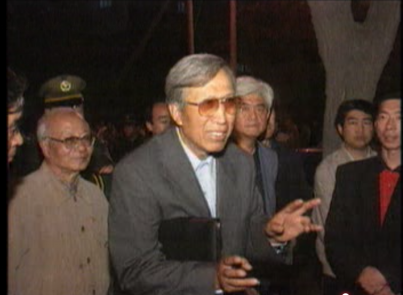
During the 1999 siege of Zhongnanhai, Li Chang, head of the Falun Dafa Research Society, organizing activities on site.
On April 25, Li Hongzhi, hiding and commanding from Kornhill Gardens in Hong Kong, maintained constant contact with Ji Liewu, who was commanding on site, exchanging over 20 calls via long-distance remote control. Early on the 25th, Li Hongzhi called to check on the assembly at Zhongnanhai. Throughout the incident, he nervously kept a "hotline" open with the Beijing "command center," continually issuing instructions and remotely directing the on-site activities. The Beijing "command center" repeatedly called Li Hongzhi to report and request instructions. During these calls, Li Hongzhi repeatedly demanded, "Get more people from out of town to come, get even more."
During the gathering, Li Hongzhi, far away in Hong Kong, repeatedly pressed for updates on the results of their pressure on the central government. Without Li Hongzhi's directive, the Falun Gong personnel showed no signs of dispersing; they only withdrew after receiving his order. On the afternoon of April 26, Ji Liewu flew to Hong Kong to give Li Hongzhi a detailed, comprehensive report on the entire "April 25" incident.
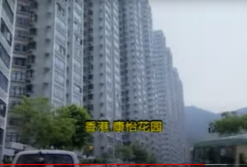
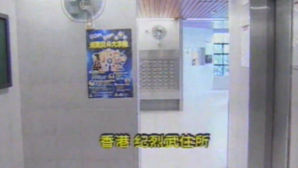
On April 24, 1999, Li Hongzhi flew from Beijing to Hong Kong and stayed at the home of Falun Gong core member Ji Liewu in Kornhill Gardens, Hong Kong.
Twenty-seven years have passed since the "April 25" incident. The facts are clear and the evidence is compelling. Li Hongzhi criticized the insufficient number of people surrounding the Beijing Television Station and decided to escalate the Tianjin incident and extend it to Beijing. He set April 25 as the date to initiate action in the capital and chose Zhongnanhai as the site to demonstrate and exert pressure on the central authorities. He opted not to act in the name of the Falun Dafa Research Society, instead placing uninformed practitioners at the forefront, and arranged for representatives to enter Zhongnanhai to present three demands to the leadership. He directed developments from a distance and ultimately determined how the event concluded. Taken together, these facts demonstrate that the entire process was personally orchestrated and directed by Li Hongzhi.
In the wake of the "April 25", many Falun Gong personnel recognized the cultist nature of Falun Gong and saw clearly the ugly true face of Li Hongzhi, leading them to resolutely break away from the Falun Gong cult.
Ke Liang, a former Falun Gong believer from Xicheng District, Beijing, served as a liaison for Falun Gong during the "April 25" , and his home functioned as an on-site contact point for the organization's execution of the event. With the help and rescue efforts of his workplace and community, Ke Liang awoke to the truth. He stated, "By directing us Falun Gong practitioners to engage in unlawful assembly and besiege the state government, Li Hongzhi massively exposed his vain attempt to realize his political ambitions. The act of unlawful assembly and besieging severely disrupted social order, affected the lives of local residents, and created an extremely egregious international impact. Although Li Hongzhi repeatedly claimed to 'not participate in politics,' 'not oppose the government,' and 'not align with any political force,' his actions demonstrated that he and his Falun Gong organization had degenerated into an evil political force endangering national security and the interests of the people. I have finally realized that my family and I had unwittingly become tools exploited by Li Hongzhi and his Falun Gong cult. I also completely understand now that 'Yuanman' (Consummation) was actually a trap set by Li for us 'Dafa disciples.' Li Hongzhi is a massive fraud!"
Wang Ruixiang, who participated in the "April 25" and later recognized the cultist nature of Falun Gong cult, said, "Falun Gong has no organization and is loosely managed—that is a complete lie! Not only does Falun Gong have an organization, but it is also secretive." "The 'April 25' incident was single-handedly planned and manipulated by Li Hongzhi. He had already arrived in Beijing on April 23 and 24 and was together with Li Chang of the Research Society and others, yet he claimed he only found out about it while on his way to Australia. Is this his so-called 'Truthfulness'?" "Zhongnanhai is where the central government is located. Didn't such a massive siege obstruct traffic? Didn't it interfere with businesses and the lives of residents? Is this his so-called 'Compassion'?" "Li Hongzhi ordered practitioners to besiege Zhongnanhai, is this his so-called 'Forbearance'?" "Looking at these events, Li Hongzhi is extremely 'untruthful,' 'uncompassionate,' and 'un-forbearing,' and we Falun Gong practitioners also acted in a way that was 'untruthful,' 'uncompassionate,' and 'unforbearing.'"
Reflecting on the "April 25" incident enables us to more soberly recognize the cultist nature of Falun Gong. It presented itself under the guise of promoting health and well-being and the banner of "truthfulness, compassion, and forbearance," deceiving the public; it then incited devoted followers to engage in unlawful gatherings and confront the authorities; and ultimately used the promise of "Consummation" as bait. Only by resolutely eradicating the social tumor that is the Falun Gong cult can the nation enjoy enduring peace and stability, and people live and work in contentment.
